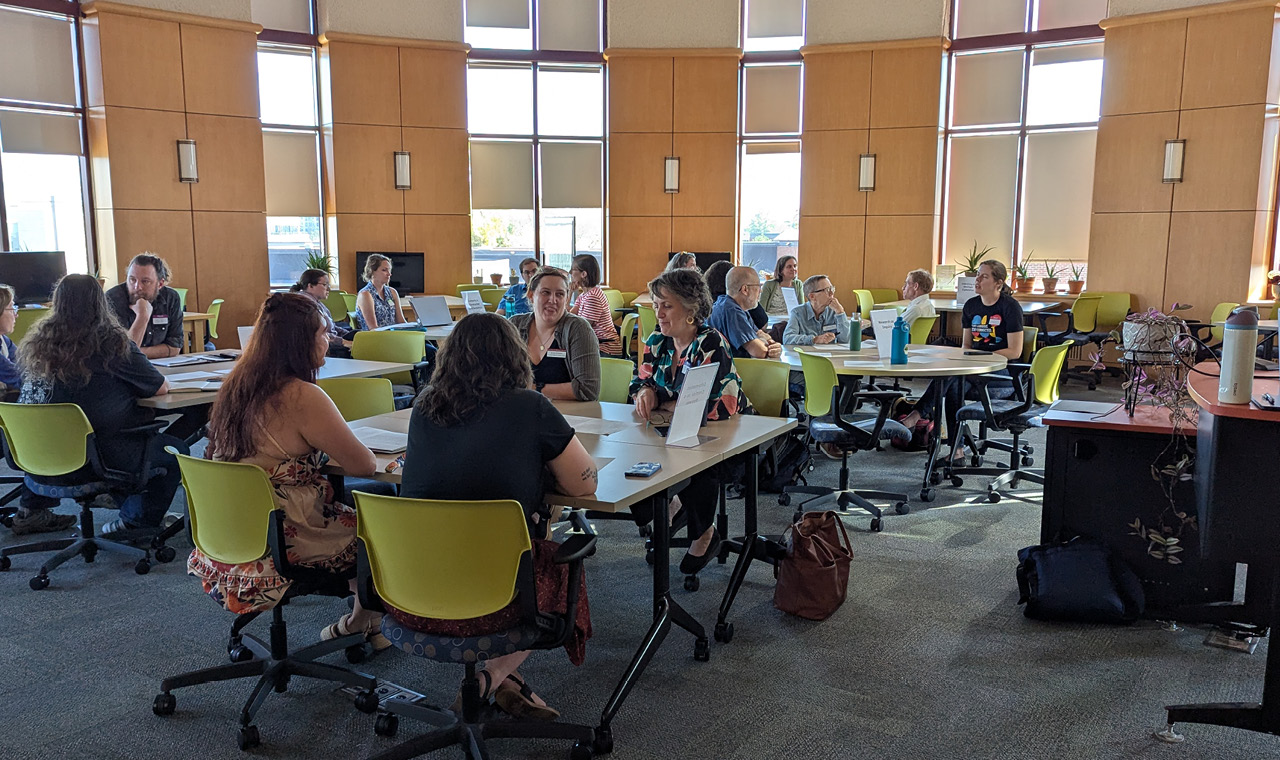
During the 2025-2026 academic year, the library partnered with the Philosophy department to lead a year-long Information Literacy Community of Practice (IL CP), funded by a Chancellor's Innovation Grant. The goal of this project was to encourage faculty to incorporate information literacy across the curriculum and empower partnerships between instructors and librarians. Throughout the academic year, faculty and staff from across campus met monthly to discuss information literacy-related topics including generative AI, the financial forces that shape social media, librarian / faculty collaboration, visual literacy, and political polarization in science communication. This program also featured campus presentations delivered by guest speakers, including Alan Rubel from the University of Wisconsin-Madison and Don Fallis and Kay Mathiesen from Northeastern University.
The IL CP culminated in a showcase of engaging lightning talks and poster presentations by participants. One of the participants, Dr. Marat Bakpayev, wrote a reflection about his IL CP experience:
This academic year I joined the Information Literacy Community of Practice - an interdisciplinary

initiative connecting the Library, the Philosophy Department, and faculty across the UMD, supported by the Chancellor’s Office Innovation Grant.
The initiative resonated with my research on how people consume information in algorithmically shaped environments. Through a series of presentations and discussions - covering social media manipulation, AI literacy, and digital misinformation - the collaboration sharpened my thinking on the mechanisms by which technological manipulation shapes consumer belief.
John Teschner’s talk on the influencer industry; Alexis Elders’ presentation on AI literacy; Don Fallis and Kay Mathiesen’s work on the epistemic threat of digital fakes; a session from the Institute for Advanced Study’s (In)Justice Series on Data & Power, examining AI as a gatekeeper; and the episode “The War on Knowledge” from Mystery AI Hype Theater 3000 all contributed to this thinking.
The takeaway running through all of it is that deepfakes, AI-generated content, and mis- or disinformation are not isolated problems - they are part of a broader erosion of our ability to tell true from fake. We live in an information environment increasingly built to exploit how people think or feel, hide who benefits, and blur the line between real and fabricated. Learning to navigate it critically is not optional - it is one of the most important skills we can help students develop.